Tuesday, March 1, 2011
Another way of invading Japan by Communist China
As many of you are aware of Chinese rapid military,economic and its territorial expansionism. Up until the early 1970’s, after the establishment of diplomatic relation between the United States of America and Communist China, the country was still way behind in many aspects such as economy, military, education, infrastructures of its main cities except the huge population that was mostly in poverty.
However, around in the middle of 1980’s, the government started to accept free market economic system, capitalism though the country itself was communism. The U.S capitalists considered that they could make huge amount of profits by using Chinese cheep labor force in constructing assembly lines in China and export their products to the U.S. and other markets in the world. That was a beginning of the issue.
After over 20 some years, Chinese Economic kept double digits growth. And now the GDP level is number two next to the U.S. though the gap between the rich and the poor is unbearably big. The rich became richer and the poor are still in poverty. Anyway, the country has gotten a huge amount of foreign government bonds and currencies reserves. Among them China is a number one country which possesses the U.S. Government Bonds.
China has developed and modernized its military power size and the ammunitions. They have nuclear missiles that can reach the U.S. And they even have raptor type fighter planes, nuclear power submarines. And now they are trying to construct some aircraft carriers.
While strengthen the military power, China has sneaky strategy to invade Japan. That is to purchase vast area of real-estate in big cities in Japan such as in Nagoya and Niigata. They are planning to unusual size of Chinese Embassy or Consulate. There’s a report saying. Chinese wants to have huge places that Japanese domestic law cannot apply and the places would become spy training facilities.

Territorial dispute between Japan and Russia.
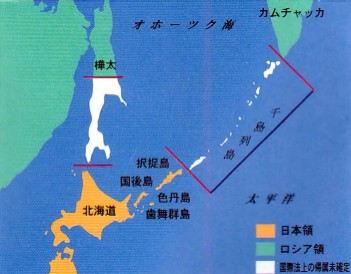
Japan's viewJapan's current view of the dispute is given in the official pamphlet of the Japanese Ministry of Foreign Affairs:[41]
The Cairo Declaration and the Potsdam Declaration did not apply to the Northern Territories because those islands had never belonged to Russia even before 1904-1905.
Russia had not previously claimed the disputed islands, not in all the time since it began diplomatic relations with Japan in 1855. Therefore the disputed islands could not be considered part of the territories acquired by Japan "by violence and greed".
The Yalta Agreement "did not determine the final settlement of the territorial problem, as it was no more than a statement by the then leaders of the Allied Powers as to principles of the postwar settlement. (Territorial issues should be settled by a peace treaty.) Furthermore, Japan is not bound by this document, to which it did not agree."[41]
Russia's 1945 entry into the war against Japan was a violation of the Soviet–Japanese Neutrality Pact, and the occupation of the islands was therefore a violation of international law. The Soviet Union repudiated the neutrality pact on April 5, 1945, but the pact remained in effect until April 13, 1946.
Although by the terms of Article (2c) of the 1951 San Francisco treaty, Japan renounced all rights to the Kuril Islands, the treaty did not apply to the islands of Kunashiri, Etorofu, Shikotan and the Habomai rocks since they are not included in the Kuril Islands. Also, the Soviet Union did not sign the San Francisco treaty.
Tuesday, February 8, 2011
Territorial dispute between Japan and Russia.
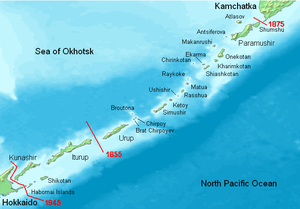
Japan's viewJapan's current view of the dispute is given in the official pamphlet of the Japanese Ministry of Foreign Affairs:[41]
The Cairo Declaration and the Potsdam Declaration did not apply to the Northern Territories because those islands had never belonged to Russia even before 1904-1905.
Russia had not previously claimed the disputed islands, not in all the time since it began diplomatic relations with Japan in 1855. Therefore the disputed islands could not be considered part of the territories acquired by Japan "by violence and greed".
The Yalta Agreement "did not determine the final settlement of the territorial problem, as it was no more than a statement by the then leaders of the Allied Powers as to principles of the postwar settlement. (Territorial issues should be settled by a peace treaty.) Furthermore, Japan is not bound by this document, to which it did not agree."[41]
Russia's 1945 entry into the war against Japan was a violation of the Soviet–Japanese Neutrality Pact, and the occupation of the islands was therefore a violation of international law. The Soviet Union repudiated the neutrality pact on April 5, 1945, but the pact remained in effect until April 13, 1946.
Although by the terms of Article (2c) of the 1951 San Francisco treaty, Japan renounced all rights to the Kuril Islands, the treaty did not apply to the islands of Kunashiri, Etorofu, Shikotan and the Habomai rocks since they are not included in the Kuril Islands. Also, the Soviet Union did not sign the San Francisco treaty.
Friday, November 5, 2010
The video about the Invasion by China was released by someone and somehow.
The video about the Invasion by China was released by someone and somehow.
The video must be longer than this but proof video was appeared on YouTube in the middle of night. There must be something to protest DPJ’s intension of concealment about the facts: the ramming of Chinese fishing boat to Japanese Coast Gourd Vessels in Japanese territory, SENKAKU.
The government managed by mostly fake Japanese assembly members of DPJ was hiding the video and had not shown it to Japanese people. There is a possibility that they erase the video as soon as they find it. So please see it immediately.
尖閣衝突ビデオ!This is the Senkaku Islands collision video on Sep 7 2010(E&J)
TRUTH OF CHINA INVASION OF SENKAKU ISLAND 1.flv
http://www.nicovideo.jp/watch/sm12648731 TRUTH OF CHINA INVASION OF SENKAKU ISLAND 3.flv
http://www.youtube.com/watch?v=6r0emFsfZCI
TRUTH OF CHINA INVASION OF SENKAKU ISLAND 4.flv
http://www.youtube.com/watch?v=VORS6SUsxmk
TRUTH OF CHINA INVASION OF SENKAKU ISLAND 5.flv
http://www.youtube.com/watch?v=ZwNFuUiw-tM TRUTH OF CHINA INVASION OF SENKAKU ISLAND 6.flv
http://www.youtube.com/watch?v=1PZZxl5tjug
TRUTH OF "CHINA INVASION OF SENKAKU ISLAND " 3 watch1:18
http://www.youtube.com/watch?v=uZV8n4oCPJ8
TRUTH OF "CHINA INVASION OF SENKAKU ISLAND " 4 Watch2:18
http://www.youtube.com/watch?v=kjqP4WszObc
ニコニコ
ニコニコ動画で見れます。
尖閣ビデオ① http://www.nicovideo.jp/watch/sm12648731
② http://www.nicovideo.jp/watch/sm12648818
③ http://www.nicovideo.jp/watch/sm12648910(
尖閣ビデオ④ http://www.nicovideo.jp/watch/sm12649050
尖閣ビデオ⑤ http://www.nicovideo.jp/watch/sm12649152
尖閣ビデオ⑥ http://www.nicovideo.jp/watch/sm12649193
⑤が衝突時の映像です。
可能ならバックアップしておいてください。
また消される可能性があります。
The video must be longer than this but proof video was appeared on YouTube in the middle of night. There must be something to protest DPJ’s intension of concealment about the facts: the ramming of Chinese fishing boat to Japanese Coast Gourd Vessels in Japanese territory, SENKAKU.
The government managed by mostly fake Japanese assembly members of DPJ was hiding the video and had not shown it to Japanese people. There is a possibility that they erase the video as soon as they find it. So please see it immediately.
尖閣衝突ビデオ!This is the Senkaku Islands collision video on Sep 7 2010(E&J)
TRUTH OF CHINA INVASION OF SENKAKU ISLAND 1.flv
http://www.nicovideo.jp/watch/sm12648731 TRUTH OF CHINA INVASION OF SENKAKU ISLAND 3.flv
http://www.youtube.com/watch?v=6r0emFsfZCI
TRUTH OF CHINA INVASION OF SENKAKU ISLAND 4.flv
http://www.youtube.com/watch?v=VORS6SUsxmk
TRUTH OF CHINA INVASION OF SENKAKU ISLAND 5.flv
http://www.youtube.com/watch?v=ZwNFuUiw-tM TRUTH OF CHINA INVASION OF SENKAKU ISLAND 6.flv
http://www.youtube.com/watch?v=1PZZxl5tjug
TRUTH OF "CHINA INVASION OF SENKAKU ISLAND " 3 watch1:18
http://www.youtube.com/watch?v=uZV8n4oCPJ8
TRUTH OF "CHINA INVASION OF SENKAKU ISLAND " 4 Watch2:18
http://www.youtube.com/watch?v=kjqP4WszObc
ニコニコ
ニコニコ動画で見れます。
尖閣ビデオ① http://www.nicovideo.jp/watch/sm12648731
② http://www.nicovideo.jp/watch/sm12648818
③ http://www.nicovideo.jp/watch/sm12648910(
尖閣ビデオ④ http://www.nicovideo.jp/watch/sm12649050
尖閣ビデオ⑤ http://www.nicovideo.jp/watch/sm12649152
尖閣ビデオ⑥ http://www.nicovideo.jp/watch/sm12649193
⑤が衝突時の映像です。
可能ならバックアップしておいてください。
また消される可能性があります。
Wednesday, November 3, 2010
Ill mind Russian President, Dmitry Medvedev visited Kunashir, which is the territory of Japanese Island with no permission to Japanese agreement.
On November 1, Russian President, Dmitry Medvedev visited Kunashir that had been invaded since the time of Soviet Union’s aggression to Japanese territories.
The purpose of this is apparently related to the territorial dispute with Red China regarding SENKAKUS. As many of you know that there are four Islands in the north of Hokkaido, Kunashiri, Habomai, Shikotan,and Etorofu. Before World War 2, there used be Japanese inhabitants on these islands as Japanese territory, but due to the incident of a sudden military invasion by Communist Russian, STALIN, all of Japanese people had to move to Hokkaido to avoid dangers of their lives abounding their houses and properties.

Facts about the territorial dispute-You Tube
At that time, Japan and Soviet Union had a neutrality treaty not to have any military conduct between Japan and Soviet Union. So Japan was even consulting Russia to stop the World War 2. However, even if the neutrality treaty was still effective and not expired, STALIN ignored it and stated send his troops to Manchuria, the South Karafuto, the Chishima Islands
and Kunashiri, STALIN used many sneaky ways to rob Japanese territories. He spoke to General MacArthur to share Hokkaido as a half the U.S. territory and the other half was Russian territory. But MacArthur did not get on this idea. I believe this was the turning point of Korean War and the Cold War with two different political and economical ideologies.
Anyway, after the Japanese surrender of World War 2, according to the San Francisco Peace Treaty, Japanese Government was forced to give up the territorial right to the South Karafuto, the Chishima Islands, but not Kunashiri, Habomai, Shikotan,and Etorofu.
This is the first time that the top of Russian president visited Japanese territory, ignoring the historical facts and evidences. Even including the time of Soviet Union, no high ranked officials visited the unlawfully occupied Japanese Islands.
We Japanese strongly protest Russian President, Dmitry Medvedev and his government to this outrageous conduct. If Russia Keep doing such idiot things, no nation would consider Russia as trustable and reliable partner in many fields, such as economical, business, environmental aspects in the world.
By the way, the U.S. has immediately announced that she was with Japanese side.
The purpose of this is apparently related to the territorial dispute with Red China regarding SENKAKUS. As many of you know that there are four Islands in the north of Hokkaido, Kunashiri, Habomai, Shikotan,and Etorofu. Before World War 2, there used be Japanese inhabitants on these islands as Japanese territory, but due to the incident of a sudden military invasion by Communist Russian, STALIN, all of Japanese people had to move to Hokkaido to avoid dangers of their lives abounding their houses and properties.
Facts about the territorial dispute-You Tube
At that time, Japan and Soviet Union had a neutrality treaty not to have any military conduct between Japan and Soviet Union. So Japan was even consulting Russia to stop the World War 2. However, even if the neutrality treaty was still effective and not expired, STALIN ignored it and stated send his troops to Manchuria, the South Karafuto, the Chishima Islands
and Kunashiri, STALIN used many sneaky ways to rob Japanese territories. He spoke to General MacArthur to share Hokkaido as a half the U.S. territory and the other half was Russian territory. But MacArthur did not get on this idea. I believe this was the turning point of Korean War and the Cold War with two different political and economical ideologies.
Anyway, after the Japanese surrender of World War 2, according to the San Francisco Peace Treaty, Japanese Government was forced to give up the territorial right to the South Karafuto, the Chishima Islands, but not Kunashiri, Habomai, Shikotan,and Etorofu.
This is the first time that the top of Russian president visited Japanese territory, ignoring the historical facts and evidences. Even including the time of Soviet Union, no high ranked officials visited the unlawfully occupied Japanese Islands.
We Japanese strongly protest Russian President, Dmitry Medvedev and his government to this outrageous conduct. If Russia Keep doing such idiot things, no nation would consider Russia as trustable and reliable partner in many fields, such as economical, business, environmental aspects in the world.
By the way, the U.S. has immediately announced that she was with Japanese side.
Sunday, October 17, 2010
Japan Rallies Against China Over Disputed Island.
On October 16, 2010, more than 35000 people including members of the national assembly marched through Tokyo to Chinese Embassy, protesting against the Communist China’s aggressiveness to invade neighboring countries. It has already
invaded Tibet, Uyghur and the part of Mongolia.
Communist China has also had territorial disputes over Parcel Islands and Spratly Islands in South China Sea among Vietnam, Malaysia, Indonesia and Philippines.
And now, Communist China wants Japanese territory, called Senkaku which is composed of 7 small islands in East China Sea. It was the first time China started to insist that the Islands had belonged to it when scientific research done by the UN announced that there was a possibility of huge amount of natural resources such as natural gas, crude oil,precious metals and chemicals.
There is no doubt that Senkaku Islands and surrounding Ocean within EEZ Line are Japanese territories. The world society should know the truth. Chinese Expansionism has three key strategies. First, controlling media, not only in domestic society but also foreign countries’ .They don’t hesitate to tell lies and fabricate false information--even a false history, and mislead the world society. Second, they make its own new laws---for example, a law which is beneficial territorial ocean law for its sake. They consider any nations that do not follow the laws would be antagonistic and that would be a reason to justify their invasions. Third, escalating the size of military power and its modernization--this includes a psychological strategy. The more Communist China’s military power becomes big, the less number of nations would be able to confront against China.
I have introduced the following news articles, ABC news and BBC News. However, I recommend these writers to make further research and to offer more accurate facts.


ABC News
Japan Rallies Against China Over Disputed Islands
October 16, 2010
TOKYO (Reuters) - Thousands of protesters marched through Tokyo on Saturday to demonstrate against what they called China's invasion of disputed islands that both countries claim.
This was the second major anti-China rally in Japan since ties between Asia's top economies worsened last month when Japan detained a Chinese trawler captain whose boat collided with Japanese patrol ships near the disputed islands -- called Senkaku in Japan and Diayu in China.
More than 2,000 protesters gathered in Aoyama Park, which is built on what was once a military shooting range, on Saturday afternoon. They marched through the busy Roppongi district to the Chinese Embassy, holding up Japanese flags and shouting slogans.
"The Senkaku islands belong to me and every Japanese. I am angry as our belongings were stolen," said a 23 year-old student, Masato Yoshida.
One of the organizers of the rally was Toshio Tamogami, a former air force chief who was sacked after publishing an essay that argued that Japan was not an aggressor in World War Two.
He also organized an October 3 rally in which around 2,700 people took part, criticizing China and blasting Prime Minister Naoto Kan's handling of the territorial dispute.
Critics charged that Kan caved in to pressure from Beijing to release the captain of the fishing trawler.
Amid the diplomatic row between the two nations, four Japanese citizens employed by construction firm Fujita Corp were detained in China on suspicion of illegally entering a military zone, but they were subsequently released.
Japan and China are trying to arrange a formal summit meeting between the two countries' leaders at the end of October on the sidelines of a regional summit in Vietnam.
Kan and Chinese Premier Wen Jiabao both called for better ties at an informal meeting this month, but they also stressed their claims to the uninhabited islands, near potentially huge oil and gas reserves in the East China Sea.
BBC NEWS
Q&A: China-Japan islands row
The row concerns eight small islands or rocks in the East China Sea
Ties between China and Japan have been strained by a territorial row over a group of islands, known as the Senkaku islands in Japan and the Diaoyu islands in China. The BBC looks at the background to the row.
What is the row about?
The eight uninhabited islands and rocks in question lie in the East China Sea. They have a total area of about 7 sq km and lie northeast of Taiwan, east of the Chinese mainland and southeast of Japan's southern-most prefecture, Okinawa.
They matter because they are close to strategically important shipping lanes, offer rich fishing grounds and are thought to contain oil deposits.
The islands are controlled by Japan. The latest row, in September 2010, was sparked by Japan's seizure of a Chinese trawler that collided with two coast guard vessels near to the islands.
What is Japan's claim?
Japan says it surveyed the islands for 10 years and determined that they were uninhabited. That being the case, on 14 January 1895 it erected a sovereignty marker that formally incorporated the islands into Japanese territory. The Senkaku islands became part of the Nansei Shoto islands - also known as the Ryukyu islands and now as modern-day Okinawa prefecture.
After World War II Japan renounced claims to a number of territories and islands including Taiwan in the 1951 Treaty of San Francisco. But under the treaty the Nansei Shoto islands came under US trusteeship and were then returned to Japan in 1971, under the Okinawa reversion deal.
Japan says that China raised no objections to the San Francisco deal. And it says that it is only since the 1970s, when the issue of oil resources in the area emerged, that Chinese and Taiwanese authorities began pressing their claims.
What is China's claim?
China says that the Diaoyu islands have been part of its territory since ancient times, serving as important fishing grounds administered by the province of Taiwan. The Ministry of Foreign Affairs says that this is "fully proven by history and is legally well-founded".
Taiwan was ceded to Japan in the Treaty of Shimonoseki in 1895, after the Sino-Japanese war. When Taiwan was returned in the Treaty of San Francisco, China says the islands - as part of it - should also have been returned. But Beijing says Kuomintang leader Chiang Kai-shek did not raise the issue, even when the Diaoyu islands were named in the later Okinawa reversion deal, because he depended on the US for support.
Separately, Taiwan also claims the islands.
Have there been incidents before?
China's Ministry of Foreign Affairs says that the issue should be shelved for future settlement and that the two sides should try to prevent it from becoming "a disturbing factor" in bilateral ties. There have nonetheless been sporadic incidents over the islands.
In 1996 a Japanese group established a lighthouse on one of the islands. Chinese activists then sailed repeatedly to the islands and in one incident, Hong Kong activist David Chan jumped into the sea and drowned. Since then, there have been periodic attempts by Chinese and Taiwanese activists to sail to the islands. In 2004, Japan arrested seven Chinese activists who landed on the main island.
There have also been face-offs between Japanese patrol boats and Chinese or Taiwanese fishing vessels. In 2005, 50 Taiwanese fishing boats staged a protest in the area, complaining of harassment by Japanese patrols.
So what next?
The Senkaku/Diaoyu issue complicates efforts by Japan and China to resolve a dispute over oil and gas fields in the East China Sea that both claim.
It also highlights the more robust attitude China has been taking to its territorial claims in both the East China Sea and the South China Sea in recent months.
In the latest row, Beijing cancelled talks on the oil and gas field issue. Small anti-Japanese protests were held in several cities in China.
China also cancelled a visit by 1,000 Japanese students to the Shanghai Expo and a concert by a top Japanese band.
In the end, Japan released the entire crew of the trawler - first the 14-member crew and then the captain, several days later.
invaded Tibet, Uyghur and the part of Mongolia.
Communist China has also had territorial disputes over Parcel Islands and Spratly Islands in South China Sea among Vietnam, Malaysia, Indonesia and Philippines.
And now, Communist China wants Japanese territory, called Senkaku which is composed of 7 small islands in East China Sea. It was the first time China started to insist that the Islands had belonged to it when scientific research done by the UN announced that there was a possibility of huge amount of natural resources such as natural gas, crude oil,precious metals and chemicals.
There is no doubt that Senkaku Islands and surrounding Ocean within EEZ Line are Japanese territories. The world society should know the truth. Chinese Expansionism has three key strategies. First, controlling media, not only in domestic society but also foreign countries’ .They don’t hesitate to tell lies and fabricate false information--even a false history, and mislead the world society. Second, they make its own new laws---for example, a law which is beneficial territorial ocean law for its sake. They consider any nations that do not follow the laws would be antagonistic and that would be a reason to justify their invasions. Third, escalating the size of military power and its modernization--this includes a psychological strategy. The more Communist China’s military power becomes big, the less number of nations would be able to confront against China.
I have introduced the following news articles, ABC news and BBC News. However, I recommend these writers to make further research and to offer more accurate facts.
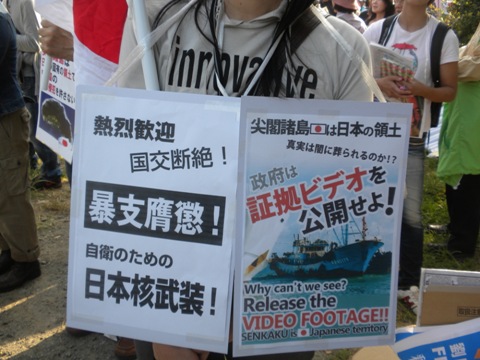

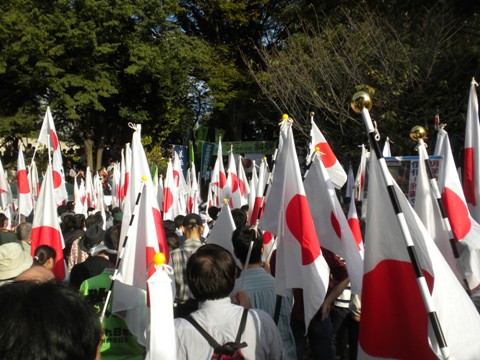
ABC News
Japan Rallies Against China Over Disputed Islands
October 16, 2010
TOKYO (Reuters) - Thousands of protesters marched through Tokyo on Saturday to demonstrate against what they called China's invasion of disputed islands that both countries claim.
This was the second major anti-China rally in Japan since ties between Asia's top economies worsened last month when Japan detained a Chinese trawler captain whose boat collided with Japanese patrol ships near the disputed islands -- called Senkaku in Japan and Diayu in China.
More than 2,000 protesters gathered in Aoyama Park, which is built on what was once a military shooting range, on Saturday afternoon. They marched through the busy Roppongi district to the Chinese Embassy, holding up Japanese flags and shouting slogans.
"The Senkaku islands belong to me and every Japanese. I am angry as our belongings were stolen," said a 23 year-old student, Masato Yoshida.
One of the organizers of the rally was Toshio Tamogami, a former air force chief who was sacked after publishing an essay that argued that Japan was not an aggressor in World War Two.
He also organized an October 3 rally in which around 2,700 people took part, criticizing China and blasting Prime Minister Naoto Kan's handling of the territorial dispute.
Critics charged that Kan caved in to pressure from Beijing to release the captain of the fishing trawler.
Amid the diplomatic row between the two nations, four Japanese citizens employed by construction firm Fujita Corp were detained in China on suspicion of illegally entering a military zone, but they were subsequently released.
Japan and China are trying to arrange a formal summit meeting between the two countries' leaders at the end of October on the sidelines of a regional summit in Vietnam.
Kan and Chinese Premier Wen Jiabao both called for better ties at an informal meeting this month, but they also stressed their claims to the uninhabited islands, near potentially huge oil and gas reserves in the East China Sea.
BBC NEWS
Q&A: China-Japan islands row
The row concerns eight small islands or rocks in the East China Sea
Ties between China and Japan have been strained by a territorial row over a group of islands, known as the Senkaku islands in Japan and the Diaoyu islands in China. The BBC looks at the background to the row.
What is the row about?
The eight uninhabited islands and rocks in question lie in the East China Sea. They have a total area of about 7 sq km and lie northeast of Taiwan, east of the Chinese mainland and southeast of Japan's southern-most prefecture, Okinawa.
They matter because they are close to strategically important shipping lanes, offer rich fishing grounds and are thought to contain oil deposits.
The islands are controlled by Japan. The latest row, in September 2010, was sparked by Japan's seizure of a Chinese trawler that collided with two coast guard vessels near to the islands.
What is Japan's claim?
Japan says it surveyed the islands for 10 years and determined that they were uninhabited. That being the case, on 14 January 1895 it erected a sovereignty marker that formally incorporated the islands into Japanese territory. The Senkaku islands became part of the Nansei Shoto islands - also known as the Ryukyu islands and now as modern-day Okinawa prefecture.
After World War II Japan renounced claims to a number of territories and islands including Taiwan in the 1951 Treaty of San Francisco. But under the treaty the Nansei Shoto islands came under US trusteeship and were then returned to Japan in 1971, under the Okinawa reversion deal.
Japan says that China raised no objections to the San Francisco deal. And it says that it is only since the 1970s, when the issue of oil resources in the area emerged, that Chinese and Taiwanese authorities began pressing their claims.
What is China's claim?
China says that the Diaoyu islands have been part of its territory since ancient times, serving as important fishing grounds administered by the province of Taiwan. The Ministry of Foreign Affairs says that this is "fully proven by history and is legally well-founded".
Taiwan was ceded to Japan in the Treaty of Shimonoseki in 1895, after the Sino-Japanese war. When Taiwan was returned in the Treaty of San Francisco, China says the islands - as part of it - should also have been returned. But Beijing says Kuomintang leader Chiang Kai-shek did not raise the issue, even when the Diaoyu islands were named in the later Okinawa reversion deal, because he depended on the US for support.
Separately, Taiwan also claims the islands.
Have there been incidents before?
China's Ministry of Foreign Affairs says that the issue should be shelved for future settlement and that the two sides should try to prevent it from becoming "a disturbing factor" in bilateral ties. There have nonetheless been sporadic incidents over the islands.
In 1996 a Japanese group established a lighthouse on one of the islands. Chinese activists then sailed repeatedly to the islands and in one incident, Hong Kong activist David Chan jumped into the sea and drowned. Since then, there have been periodic attempts by Chinese and Taiwanese activists to sail to the islands. In 2004, Japan arrested seven Chinese activists who landed on the main island.
There have also been face-offs between Japanese patrol boats and Chinese or Taiwanese fishing vessels. In 2005, 50 Taiwanese fishing boats staged a protest in the area, complaining of harassment by Japanese patrols.
So what next?
The Senkaku/Diaoyu issue complicates efforts by Japan and China to resolve a dispute over oil and gas fields in the East China Sea that both claim.
It also highlights the more robust attitude China has been taking to its territorial claims in both the East China Sea and the South China Sea in recent months.
In the latest row, Beijing cancelled talks on the oil and gas field issue. Small anti-Japanese protests were held in several cities in China.
China also cancelled a visit by 1,000 Japanese students to the Shanghai Expo and a concert by a top Japanese band.
In the end, Japan released the entire crew of the trawler - first the 14-member crew and then the captain, several days later.
Monday, October 4, 2010
Hey, Red China, listen to the world!!
The World has started to realize the stupidity of Red China’s military expansionism.
http://online.wsj.com/article/SB10001424052748704419504575527664218726440.html
http://edition.cnn.com/2010/WORLD/asiapcf/10/02/japan.anti.china.protest/index.html
http://www.thairath.co.th/content/oversea/115814
http://online.wsj.com/article/SB10001424052748704419504575527664218726440.html
http://edition.cnn.com/2010/WORLD/asiapcf/10/02/japan.anti.china.protest/index.html
http://www.thairath.co.th/content/oversea/115814
Subscribe to:
Posts (Atom)